
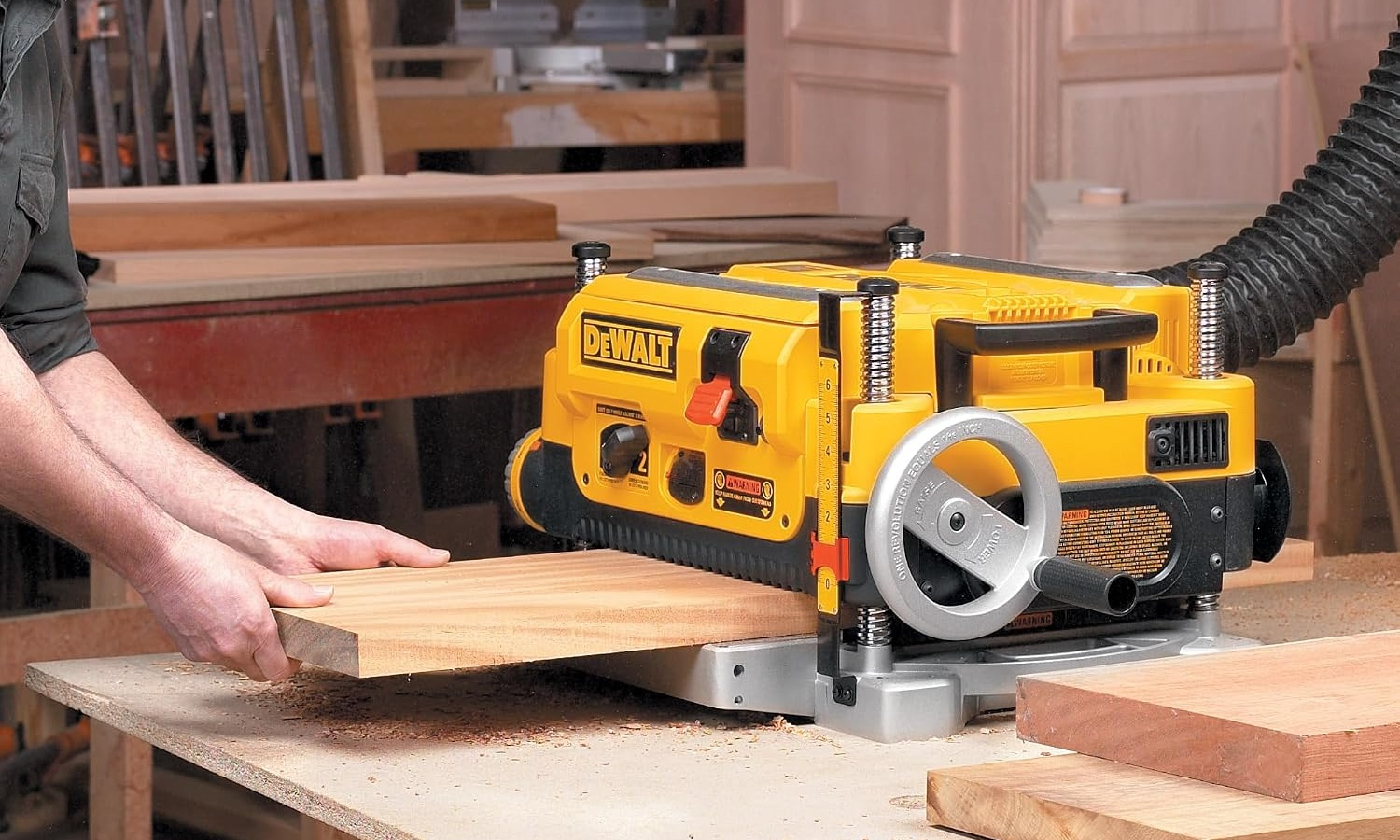
In my opinion, a thickness planer is an essential tool for most woodworking shops.
Why I bought a planer
My original use case for a planer was a table. The tabletop consisted of several boards glued together, so all the boards required the same thickness to create a perfectly flat surface.
You can pay a premium to have the boards milled to the same thickness, but it’s a significant premium. The larger the tabletop, the more quickly you’ll justify the cost of a planer.
Before I had a planer, I would work to ensure that one side was flat (the top). Then, I’d compensate for a not-perfectly-flat bottom by adjusting the legs. But sometimes you need both sides to be flat, like with a cutting board or countertop. One of my rookie mistakes was to try to sand my way to a flat top. It took forever and never worked to my satisfaction.
The Good Stuff
- It’s a workhorse. At this point, I’ve probably run a dozen species of wood through the planer with no problems. I’ve done 12-foot boards where the motor is stressed for long runs. I’ve done a dozen 4-foot boards where the motor is stressed for short runs but left running in between. Either way, this Dewalt planer just keeps on going!
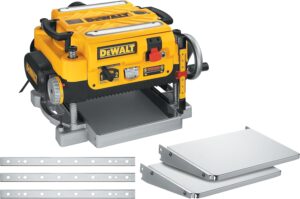
- Wings. The 735X comes with in-feed and out-feed wings that are very helpful. In fact, I’d say they are essential unless you’re using the planer on a cart with built-in wings.
- Dimensioning vs Finishing Cut. The planer has a two-speed gear box that can perform 96 cuts per inch for dimensioning and 179 cuts per inch for finishing. I leave it set to dimensioning for most of my work because it’s faster and doesn’t fill up my dust collection bin as quickly. However, it’s nice to be able to flip a switch when you’re working on furniture because it saves a lot of sanding time.
The Bad Stuff
- The only true con is that the exhaust port points straight out the back of the planer. So when you have your vacuum hose connected, the hose hangs over the outfeed wing and invariably gets in the way. You can buy 3D-printed adapters to turn the hose away from the outfeed, but that’s another $30 when Dewalt should just redesign the exhaust port.
- And while I didn’t want to pay extra for a vacuum hose adapter, I was willing to pay extra for a digital planer gauge. The default gauge is just a vertically mounted tape measure. It works fine, but it’s difficult to get the same precise thickness from board to board. A digital readout allows you to be very precise.
Conclusion
The Dewalt Thickness Planer (735 or 735X) is a strong, durable, and reliable machine that should be in every woodworking shop. I most often use it to mill boards for tabletops, but it’s also great for cleaning up 2x4s from the big box stores and restoring used lumber.
By the way, the link takes you to the product page on Amazon.com and if you subsequently buy it I will earn a small commission. Please know this does not change the price. If you go to the product page without using my link, you will see the same price. Here’s the official disclosure statement. As an Amazon Associate I earn from qualifying purchases. Thank you for supporting Moto Woodworks!
Finally, I only recommend products that I use on a regular basis and have proved their worthiness over time. Check out the Product Reviews page to see more.